
How Big Do Boerboels Get? A Breeder’s Guide to Size & Growth

🐾 Education · Size & Growth

How big do
Boerboels get?

Adult height and weight, a real growth timeline, and the one thing that matters more than any number on the scale. A breeder’s straight answer to the question we’re asked most.
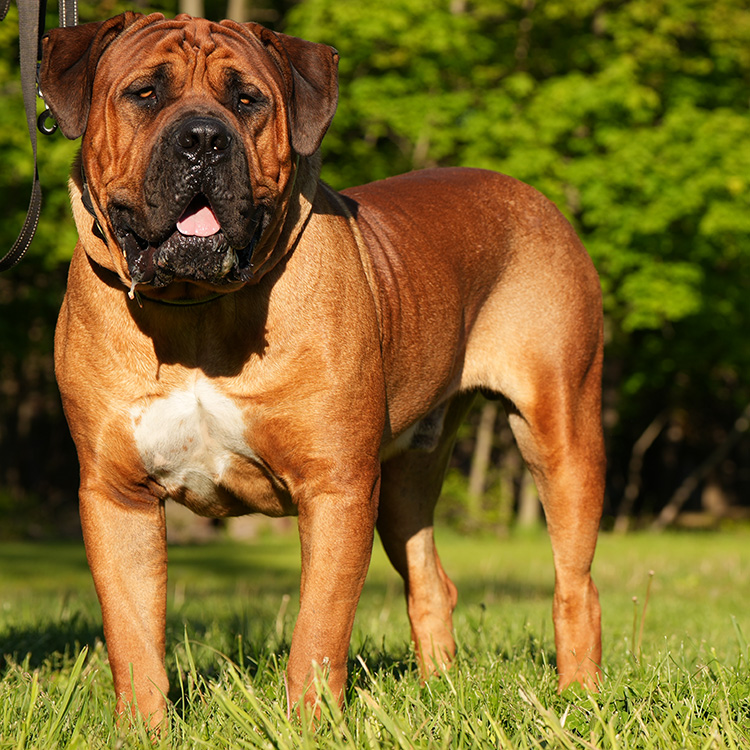
Head-on portrait of a balanced adult South African Boerboel — heavy bone, large head, even proportions.

Every prospective owner asks it first, and it’s the right question to ask: how big does this dog actually get? Here’s the honest answer — the numbers, the timeline, and why we’d rather talk about proportion than poundage.

The short answerA big dog, by any measure

Every well-bred Boerboel is a big dog. Set one beside most breeds and the difference is immediate: broad, blocky heads, heavy bone, and real mass. A grown male typically runs 150–200 pounds and stands 24–27 inches at the shoulder. Females are lighter and finer, but make no mistake — even a female stands well above the average dog.

But the headline number is the least interesting part of the answer. Two dogs can weigh the same and be worlds apart in quality. What separates a great Boerboel from a heavy one is balance.

Males vs femalesThe numbers, side by side

Here’s a healthy range to expect for a properly built dog. Read these as guides, not goals — a dog at the lower end of the scale with correct structure beats an oversized one every time.

Measure
Male
Female
Adult weight
150–200 lbs
110–165 lbs
Height at shoulder
24–27 in
22–25 in
Mostly grown
~12–14 months
~12–14 months
Fully mature
~2.5–3 years
~2–2.5 years
Ranges are healthy guides for a well-built dog — not targets to chase.
Substance with proportion — heavy bone and a large head, but balanced in height to width.

The growth timelineHow a Boerboel grows up

A Boerboel doesn’t arrive at its adult size in a straight line. The frame finishes before the body does — height comes first, then the long, slow fill of muscle, chest, and head. Rushing any part of it is where problems start.

1
0–4 months · Foundation
Fast early growth and a bottomless appetite. The goal here isn’t to push size — it’s lean, steady gain on quality nutrition, with joints protected from hard impact and over-exercise.
2
4–12 months · The stretch
The puppy goes tall and leggy, often looking gangly and “unfinished.” This is normal. Keep growth controlled and even — a dog that shoots up too fast outpaces the muscle and connective tissue meant to support it.
3
12–18 months · Filling the frame
Height largely sets by 12–14 months. Now the dog begins to broaden and pack on muscle through the chest, neck, and hindquarters. Structured conditioning matters more than mileage.
4
2–3 years · Full maturity
The head, chest, and overall mass keep developing until roughly 2.5–3 years in males. This is when a Boerboel finally looks like the finished article — and why patience is everything.

Why controlled growth winsSlow is the whole game

A healthy Boerboel has a healthy appetite — and left unchecked, that appetite will grow a puppy faster than its frame can support. When the skeleton outruns the muscle and ligaments meant to hold it together, you trade long-term soundness for a few early pounds. It’s a bad trade.

What controlled growth protects

Joints — Even, measured growth gives hips and elbows the best shot at developing soundly under all that weight.

Structure — Muscle and connective tissue get time to catch up to the skeleton, so the frame is actually supported.

Longevity — A dog built slowly and correctly holds up for years; one rushed to maximum size rarely does.

Key takeaway — Don’t chase size for its own sake — chase balanced, controlled growth. A frame that outgrows the muscle meant to carry it is a liability, not an upgrade.

How big is too big?When bigger becomes worse

There’s a market obsession with ever-larger Boerboels, and it does the breed no favors. Pushing mass past the standard stresses joints, heart, and lifespan, and breeds out the athleticism that defines the dog. A correct Boerboel is substantial and powerful but still able to breathe, run, and work.

The Boerboel spectrum
Heavier · PowerBalance ★Athletic · Speed
Holds the line. Settled, immovable, intimidating without effort.Runs the perimeter. Fast, agile, high-endurance.

We breed toward the middle — substantial and powerful, but still able to breathe, run, and do the job. Sacrifice function for size and you don’t have a Boerboel; you have a statue.

We breed toward the middle of that spectrum on purpose. Sacrifice function for size and you don’t have a better Boerboel — you have a statue.

Quick questionsSize, in a sentence

A male typically weighs 150–200 lbs and stands 24–27 inches; females are lighter at roughly 110–165 lbs and 22–25 inches. Even a female is larger than the average dog.

Most of the height is set by 12–14 months, but the dog keeps filling out in muscle, chest, and head until about 2.5–3 years of age.

No. Balance beats bulk. Pushing size past the standard costs you joints, athleticism, and years — a well-proportioned dog is always the better animal.

Rapid weight gain, a heavy “loaded” front, or soft, swollen joints are warning signs. The fix is controlled nutrition and measured exercise — talk to your breeder or vet early.

We don’t breed for the biggest dog in the room. We breed for the soundest one — and the soundest one lasts.

Jordan Pittman · Exotic Boerboels

Jordan Pittman standing beside a balanced, well-built Boerboel.

🐾 Want to see one in person?

Numbers tell you size.
A great dog tells you everything.

The best way to understand Boerboel size is to stand next to a balanced, well-built one. Call Jordan to talk through what to look for — and to meet the real thing.