
Boerboel
questions, answered
The questions we get asked most about the South African Boerboel — size, temperament, cost, legality, and how this dog really compares to the breeds it’s measured against. Straight answers, from 20 years inside the breed.
If you’re researching the Boerboel, you’ve probably found a lot of noise and not many straight answers. Here are the questions people ask us most — answered plainly, the way we’d answer them on the phone.
Minimal
Low to average
Excellent, when raised in-home
With proper socialization
Very high — needs a job
Eager, but needs leadership
Moderate
Quiet — only when it matters
The most-asked questionHow big do Boerboels get?
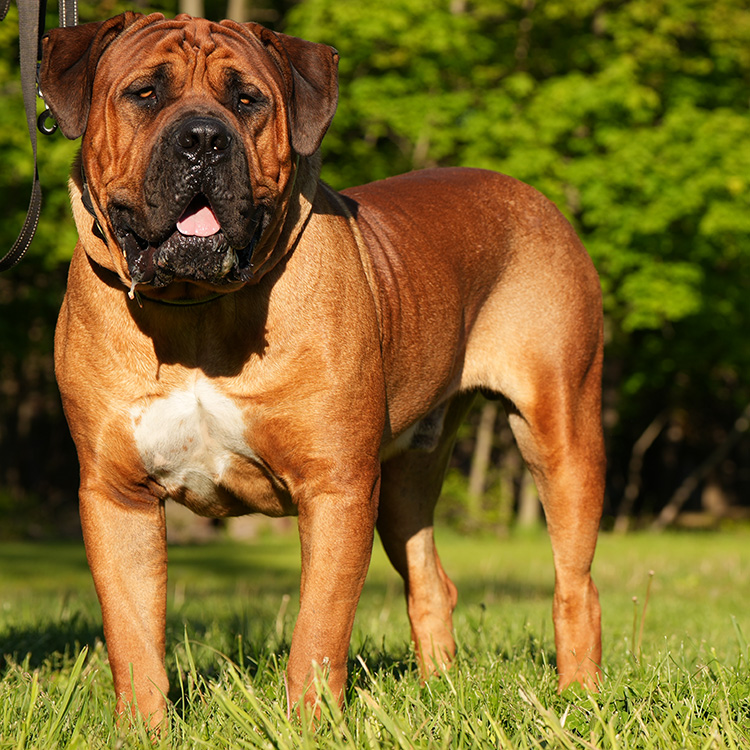
Every well-bred Boerboel is a big dog. Set one next to most breeds and the difference is obvious: broad, blocky heads, heavy bone, and real mass. Even a female stands larger than the average dog. But the headline number matters far less than the proportions.
A correct Boerboel is balanced — thickly muscled from front to back, even in height and width, and crowned with the large, impressive head the breed is known for. That balance, not raw size, is what makes a Boerboel look and move like a Boerboel.

Because the breed draws on a diverse lineage, you’ll see a wide range of adult sizes. What matters most isn’t how big a Boerboel gets — it’s how it gets there. Slow, controlled growth is everything. A healthy Boerboel has a healthy appetite, and left unchecked that appetite can push a puppy to grow faster than its frame can support.
Behavior & the familyTemperament & family
Almost every question we get about temperament traces back to the same misunderstanding: people confuse capable with dangerous. Here’s how the breed actually behaves in a home.
The Boerboel is confident, calm and deeply devoted to its family. They are intelligent, intuitive guardians — watchful with strangers but gentle and affectionate with their own people. A correct Boerboel is stable and discerning, not nervous or reactive.
This is a thinking breed that bonds hard. Raised and socialized well, they are steady, loyal companions.
They can — especially when raised with other animals and properly socialized from a young age. Boerboels can be same-sex selective as adults, so thoughtful introductions and supervision matter.
Many of our dogs live happily alongside other pets; early, positive exposure is the difference-maker.
Activity & intelligenceHow much exercise do Boerboels need?
Boerboels need a moderate amount of physical exercise — but the physical side is the smaller half of the equation. What this breed really needs is mental work. These are highly intelligent dogs that need a job and the chance to use their minds; an under-stimulated Boerboel is where most “problem” behavior actually comes from.
The exact requirement depends on the dog. Larger, heavier Boerboels generally need less; lighter, higher-drive dogs want more activity. The most useful way to think about it: exercise is purposeful activity, not just burning energy. Every Boerboel needs a sense of purpose.
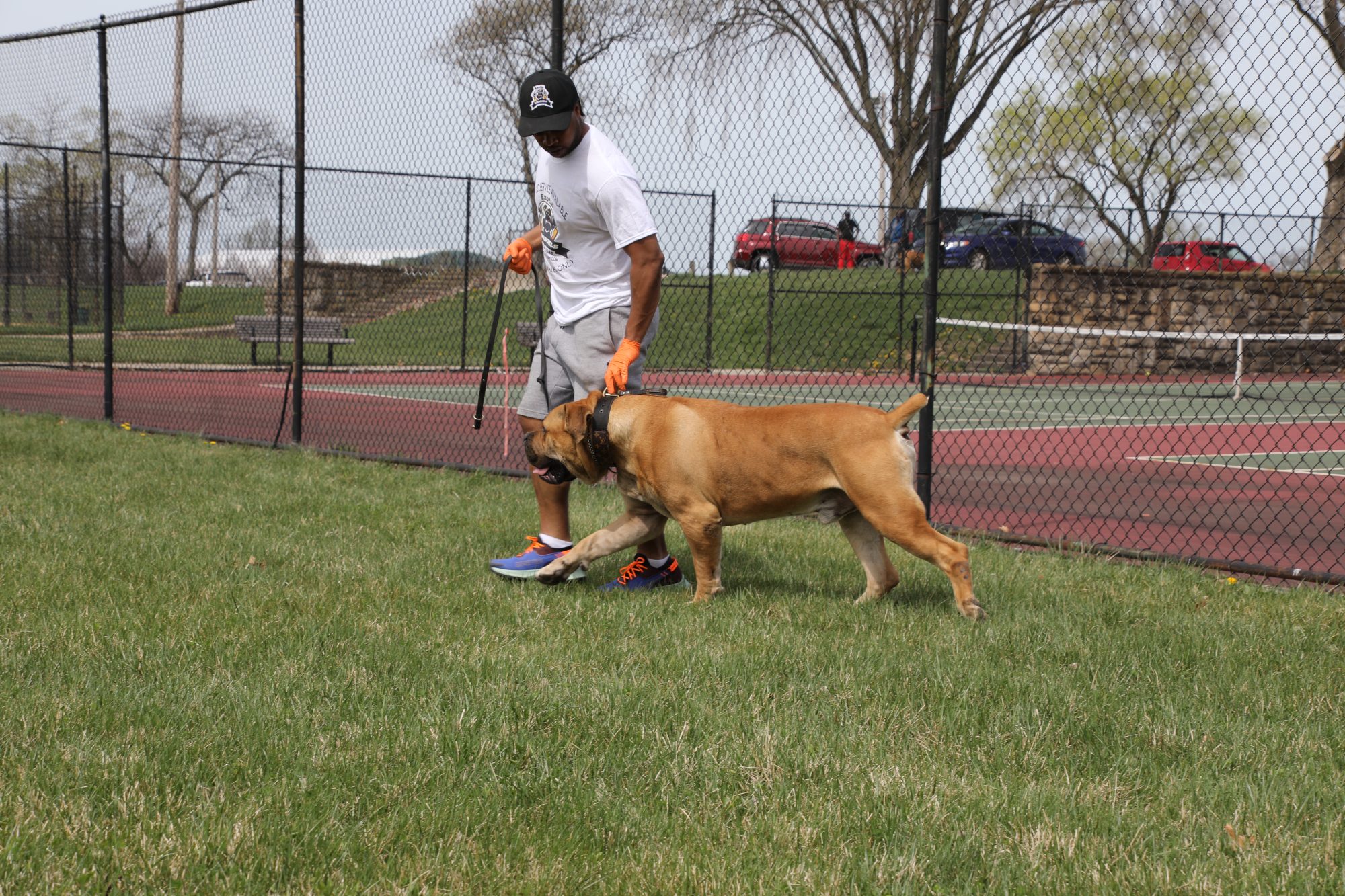
Most Boerboels sit comfortably in the middle — content to settle indoors, but ready to work when you are. They’re not a low-energy couch breed, and they’re not a high-octane sport dog.
Head to headBoerboel vs other breeds
These are the comparisons people search for most. A fair note first: every breed is built for a different job, and “better” only means anything relative to purpose. The Boerboel was shaped as a first line of defense against serious, dangerous threats — and that’s the lens these comparisons are made through.
Boerboel — stronger
Boerboel — bigger
Boerboel — stronger
Comparisons reflect breed purpose and our experience inside the breed — every individual dog is its own animal.
Coat, color & geneticsWhat is a Boerboel’s coat like?
The Boerboel wears a short, dense, smooth coat with a soft undercoat — practical, weatherproof, and famously low-maintenance. Here’s the full picture — texture, length, the colors the breed comes in, and the color-and-genetics questions we hear most.
Most carry a black mask. The coat is short, dense and smooth — built for function, not fuss.
That easy coat translates directly into how little work these dogs are to keep — both in what they leave on your floor and what they ask of you.
Low to average. You’ll find some hair, especially in seasonal changes, but nothing like a double-coated northern breed. Good nutrition keeps shedding down and the coat healthy.
Minimal. An occasional brush, nails, ears, and teeth — that’s the routine. A clean, well-fed Boerboel essentially maintains itself.
Yes. We are proud to be one of the programs working with black Boerboels, and our Boobie was the first black Boerboel showcased in the American Kennel Club. We breed for the whole dog — structure, temperament and health first — with color as a bonus.
This is a debated topic in the breed. Historically the registries did not recognize solid black, so some consider it non-standard. Genetically, a black Boerboel from two Boerboel parents is a Boerboel — the color comes from a recessive gene, not from crossbreeding, when it’s produced responsibly within proven lines.
We’re transparent about our dogs’ pedigrees and happy to walk you through them. Call 216-244-2088 if you want the full story.
“Blue” refers to a dilute coat — a grayish cast caused by the dilution gene. It does occur, but it is not a traditional or standard Boerboel color, and dilute coats can be associated with skin issues in some lines. We prioritize health and correctness over chasing rare colors.
A traditional Boerboel does not have Rottweiler-style tan points. Boerboels come in fawn, red, brown and brindle (usually with a black mask), plus the black we work with. Clear “black-and-tan” Rottweiler markings are not part of the classic Boerboel pattern and can be a sign of outcrossing somewhere in the line.
Cost, legality & lifespanOwning a Boerboel
The practical questions — whether they’re legal, what they cost, how long you’ll have them, what to feed them, and whether they fit your living situation.
It’s not ideal, but it can work with commitment. Boerboels are relatively calm indoors and don’t need a huge yard, but they are large, powerful dogs that need daily exercise and mental stimulation. A securely fenced yard is a big plus.
What matters most is your time and leadership — a bored, under-exercised Boerboel of any home size will be a handful.
Pricing, process & pickupGetting a Boerboel from us
The practical side of bringing one home — what the waitlist and deposit involve, how we health-test, what your puppy leaves with, and how it gets to you.
Reach out by phone or text to 216-244-2088 and we’ll talk about what you’re looking for and which upcoming litter is the best fit. A deposit reserves your place in line and your pick order within the litter.
We keep our waitlist small and personal on purpose — we want every puppy going to the right home.
It’s simple and personal: (1) reach out and tell us about your home and what you want in a dog; (2) place a deposit to reserve your spot and pick order; (3) once puppies arrive, we match temperaments to homes and you select your puppy around 5–6 weeks; (4) puppies go home at 8 weeks with their health records, guarantee and a starter kit.
We stay in touch for the life of your dog — questions are always welcome.
Nature doesn’t always cooperate. If a breeding doesn’t produce a litter, or there aren’t enough puppies to reach your pick, your deposit simply rolls forward to the next available litter — or is fully refunded if you’d rather not wait. You never lose your deposit due to something outside your control.
Yes — and it’s non-negotiable for us. Our breeding dogs are evaluated for hips, elbows and cardiac health, and we breed for sound structure and longevity, not just looks. Healthy parents are the foundation of healthy puppies.
We’re happy to discuss the health background of any dog in our program.
We feed a high-quality, protein-rich diet appropriate for a large, slow-maturing breed, and we keep our dogs lean — extra weight is hard on growing joints. We’ll send you home with feeding guidance and what your puppy is currently eating so you can transition smoothly.
Shipping varies by distance and method. Ground nanny transport typically runs a few hundred dollars within the region; flight nanny / in-cabin air is usually higher. We’ll arrange safe, reputable transport and give you an exact quote based on your location.
Many families also choose to pick up in person in the Cleveland, Ohio area — we love meeting you.
The honest answerIs the Boerboel for you?
That depends entirely on your lifestyle. Are you active, healthy, and genuinely involved day to day? How much time do you spend outside, and how much structure can you give a powerful, intelligent dog? The Boerboel rewards an engaged owner and struggles with an absent one.
If that sounds like your life, this may be the best dog you’ll ever own — and the conversation is worth having before you ever bring a puppy home.
The Boerboel gives back exactly the leadership it’s given. Bring the involvement, and there’s no better dog on earth.

Ask the breeder
before you decide
Every dog and every home is different. Call Jordan with your questions — about size, temperament, price, or whether the Boerboel fits your life — before you ever put down a deposit.